
Home » Office for Research Protections » Export Control » Item Classification Lookup
Export Control Menu
ORP Menu
Item Classification Lookup
This guide helps you identify if your research equipment, materials, or data are subject to federal export regulations. For controlled items, contact the Office of Export Compliance to determine what restrictions apply.
Important: The "Fundamental Research Exclusion"
While the results of your research are often exempt from export controls if you intend to publish them, the physical equipment and third-party data you use are NOT exempt. You must still know the classification of your tools.
How Do I Know if My Item is Controlled?
In the U.S., most research technology is governed by one of two agencies. To find out if your item is controlled, first determine which “list” your item lives on.
The U.S. Munitions List (USML)
- Regulated by: Department of State (ITAR)
- What it is: Items designed specifically for military use.
- Examples: Satellite technology, military explosives, or defense-related software.
- Action: If your item is on the USML, sharing “technical data” with a foreign person (even on campus) may require an export authorization.
The Commerce Control List (CCL)
- Regulated by: Department of Commerce (EAR)
- What it is: Items designed for civilian use that could have military applications. These are assigned an ECCN (Export Control Classification Number).
- Examples: High-speed computers, specialized lasers, or certain biological pathogens.
- Action: Check the ECCN to see if your equipment is controlled. Then, contact the OEC to see what restrictions may apply.
- Search the Commerce Control List (CCL)
How to Find the Classification
Step 1: Ask the Source
- Contact the manufacturer, vendor, or producer. They should know the classification of the products they sell.
- TIP: Check the BIS Publicly Available Classification Information table for codes from companies such as Apple, Microsoft, and Dell.
Step 2: Understand the ECCN Structure
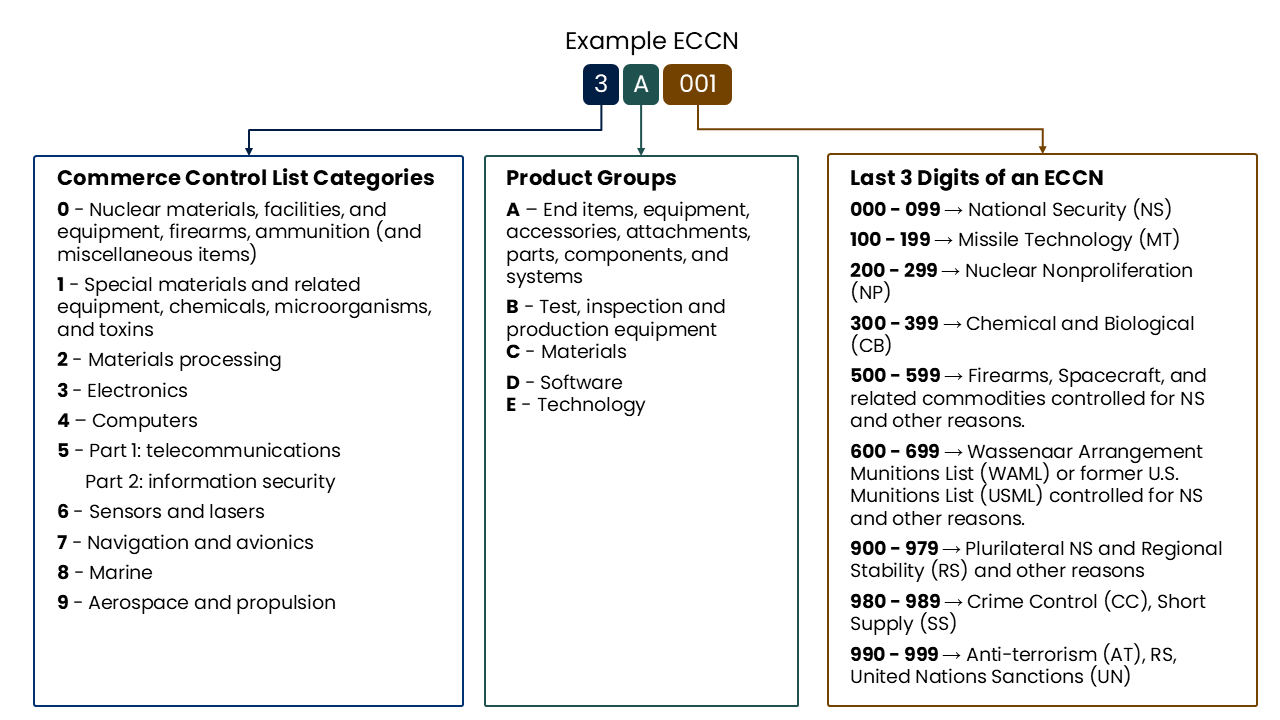
The graphic below explains the structure of an ECCN. Every ECCN is made up of 5 characters that describe exactly what the item is and why it is controlled.
Click the graphic to enlarge it.
Read Extended Description
ECCN Structure and Example Breakdown
This diagram illustrates the structure of an Export Control Classification Number (ECCN) using the example code 3A001. An ECCN is composed of three distinct parts: a category number, a product group letter, and a three-digit reason for control.
Part 1: Commerce Control List Categories (First Digit)
The first digit of the code (the “3” in 3A001) represents the broad category of the item.
0 – Nuclear materials, facilities, and equipment, firearms, ammunition (and miscellaneous items)
1 – Special materials and related equipment, chemicals, microorganisms, and toxins
2 – Materials processing
3 – Electronics
4 – Computers
5 – Part 1: telecommunications; Part 2: information security
6 – Sensors and lasers
7 – Navigation and avionics
8 – Marine
9 – Aerospace and propulsion
Part 2: Product Groups (Second Character)
The second character of the code (the “A” in 3A001) is a letter representing the specific product group.
A – End items, equipment, accessories, attachments, parts, components, and systems
B – Test, inspection and production equipment
C – Materials
D – Software
E – Technology
Part 3: Last 3 Digits of an ECCN (Reason for Control)
The final three numbers (the “001” in 3A001) indicate the primary reason the item is federally controlled.
000 – 099 → National Security (NS)
100 – 199 → Missile Technology (MT)
200 – 299 → Nuclear Nonproliferation (NP)
300 – 399 → Chemical and Biological (CB)
500 – 599 → Firearms, Spacecraft, and related commodities controlled for NS and other reasons.
600 – 699 → Wassenaar Arrangement Munitions List (WAML) or former U.S. Munitions List (USML) controlled for NS and other reasons.
900 – 979 → Plurilateral NS and Regional Stability (RS) and other reasons
980 – 989 → Crime Control (CC), Short Supply (SS)
990 – 999 → Anti-terrorism (AT), RS, United Nations Sanctions (UN)
Need Help?
Item classification can be complex. Please contact the Office of Export Compliance at export@psu.edu for assistance.
Office for Research Protections
Address
200 Innovation Blvd.
Suite 110
University Park, PA 16802
The Office for Research Protections (ORP) ensures that research at the University is conducted in accordance with federal, state, and local regulations and guidelines that protect human participants, animals, students, and personnel involved with research.