
Home » Office of Sponsored Programs » Prepare Proposals » Agency Forms and Guidelines » Navigating NIH Foreign Components
OSP Menu
Navigating NIH Foreign Components
Penn State and many of our peer institutions have recently received inquiries from the National Institutes of Health (NIH) regarding foreign collaborators listed as co-authors on publications resulting (in whole or in part) from NIH funding.
The NIH is expressing concerns that Principal Investigators are utilizing “foreign components” in the performance of their NIH-funded work without seeking required NIH prior approval (NIH Grants Policy Statement 8.1.2.10). While the definition of a foreign component has not changed (per NIH Notice NOT-OD-26-084), the NIH is placing a heightened focus on international publications and co-authorships as a mechanism to identify possible foreign components
Failure to secure prior approval for a foreign component before the work begins can result in the loss of current grant funding and restrict future federal funding. If you are unsure whether an ongoing collaboration has evolved into a foreign component, contact OSP immediately before continuing the work.
The NIH Definition of a Foreign Component
“The performance of any significant scientific element or segment of a project outside of the United States, either by the recipient or by a researcher employed by a foreign organization, whether or not grant funds are expended.
Activities that would meet this definition include, but are not limited to, (1) the involvement of human subjects or animals, (2) extensive foreign travel by recipient project staff for the purpose of data collection, surveying, sampling, and similar activities, or (3) any activity of the recipient that may have an impact on U.S. foreign policy through involvement in the affairs or environment of a foreign country.
Examples of other grant-related activities that may be significant are:
- collaborations with investigators at a foreign site anticipated to result in co-authorship;
- use of facilities or instrumentation at a foreign site; or
- receipt of financial support or resources from a foreign entity.
Foreign travel for consultation is not considered a foreign component.”
The NIH recently provided the following examples to help clarify common scenarios: (Source: NIH Extramural Nexus, June 1, 2026):
May Be A Foreign Component:
- Foreign site recruitment
- Foreign specimen / data collection
- Use of foreign lab facilities
- Co-authorship
May Not Be a Foreign Component:
- Foreign travel for consultation
- A collaborator who moved overseas after the work was completed
- Foreign vendors providing routine services
- Foreign co-author providing minor editorial feedback
The NIH Foreign Component Lifecycle
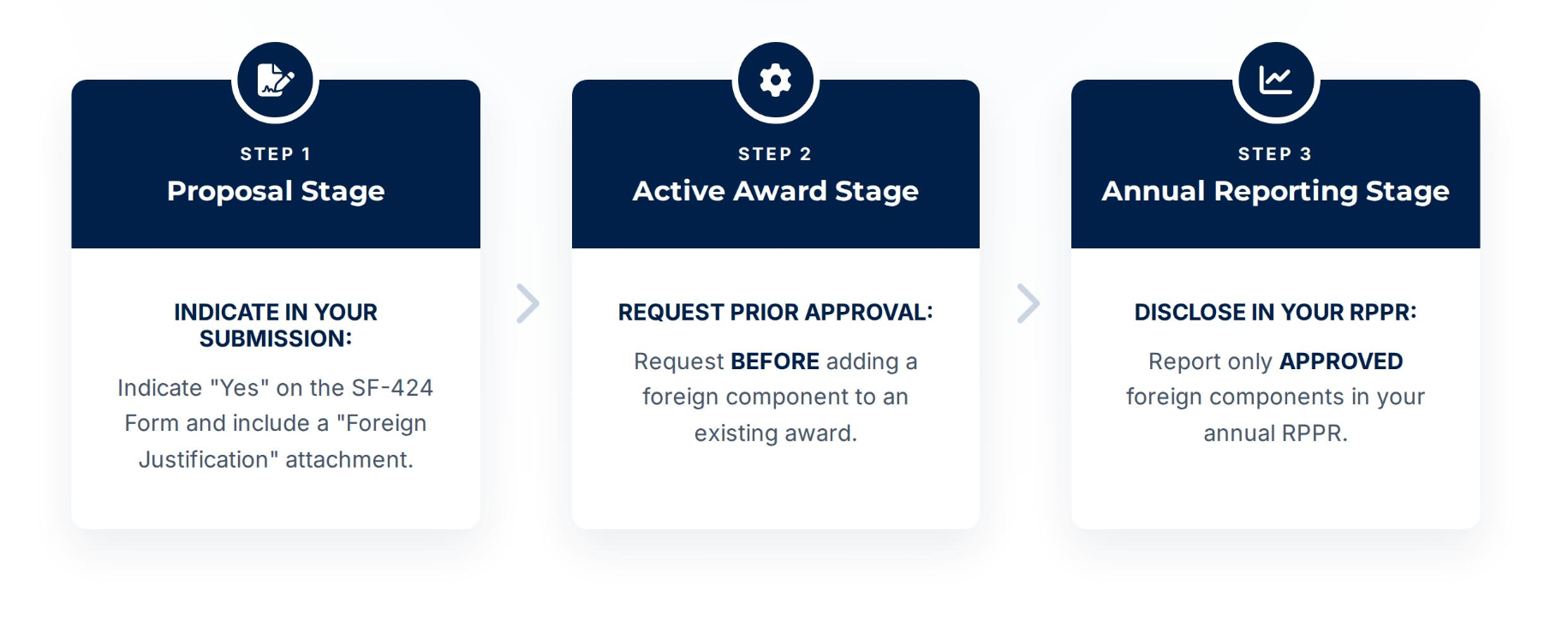 A quick visual reference for when to seek prior approval and when to disclose. Expand the section below for more stage-by-stage details.
Foreign Components & The Project Lifecycle: When to Request Prior Approval and When to Disclose
The requirement to disclose foreign components is not just a post-award issue; it applies to the entire lifecycle of your NIH funding. As indicated in the NIH’s June 2026 Extramural Nexus guidance (Acknowledging Foreign Components throughout NIH Application and Award Processes), you must acknowledge foreign components at three distinct stages:
- At Application (Pre-Award) If you are planning a project that involves conducting NIH research funded activities outside of the United States or partnering with international collaborators, you must indicate this on the SF-424 R&R Other Project Information Form. You are required to clearly explain the need for this collaboration at the time of submission using the Foreign Justification attachment.
- After the Award is Made (Post-Award) If an evolving project or new opportunity makes a foreign component necessary after the award has already been granted, you cannot begin the collaboration without NIH prior approval. Please contact your College Research Office or OSP immediately to initiate this request. The NIH will then review it to determine if the component can be added to your project.
- Annual Reporting (RPPR) You must annually report on your research progress, which includes detailing any approved foreign components. Do not use the RPPR to disclose a foreign component for the first time. If you realize an unapproved foreign component occurred during the reporting period, contact OSP immediately before submitting your RPPR so we can help you navigate the necessary corrective actions.
IMPORTANT NOTE ON OTHER SUPPORT: Just because an international collaboration or resource does not meet the strict definition of a “foreign component” does not mean you do not have to disclose it. Even if an activity takes place entirely within the U.S. and does not require prior approval (for example, a visiting scholar working in your lab who is funded by a foreign entity), it must still be disclosed to the NIH as Other Support. Prior approval and disclosure are separate requirements; when in doubt, disclose. See OSP’s webpage Current & Pending (Other) Support for more information.
What Every NIH-funded Investigator Should Do
Do Not Contact or Respond to NIH Directly
If you need to report an unanticipated foreign co-authorship, or if you receive an inquiry from your NIH Program Officer or Grants Management Specialist regarding a foreign co-author, a foreign affiliation on a publication, or an unapproved foreign component, do not respond on your own. Please forward the inquiry or report the situation immediately to Robin Riglin at rbs15@psu.edu and the Office of Sponsored Programs at osp@psu.edu. We will work with you to draft an appropriate, compliant response and navigate the reporting requirements.
Seek Prior Approval from NIH
If you are planning a new collaboration that meets the definition of a foreign component, contact your College Research Office or OSP to initiate a formal request.
NOTE: You must seek prior approval for each NIH grant and for each specific foreign component associated with that grant.
Add Author Affiliation Notes in Publications (U.S.-Based Work Exception)
If you are publishing with a co-author who performed their work while in the U.S. who now lists a foreign institutional affiliation, the NIH advises (per their June 2026 Extramural Nexus guidance) that their primary affiliation on the publication be listed as the lab where they did the work (Penn State), with a separate author note clarifying their current address.
- Example Primary Affiliation: Penn State University
- Example Author Note/Footnote: “Dr. [Name]’s contributions to this research were performed entirely while affiliated with and physically located at Penn State University. Dr. [Name]’s current address is [Foreign Institution].”
General Authorship Best Practices
Ensuring that authorship is attributed appropriately is important. For broader University guidance on authorship, click the Learn More button below to visit the Office for Research Protections’ (ORP) webpage on Authorship and Publication.
Frequently Asked Questions
Affiliations, Visas, & Students
I have postdocs, graduate students, or research faculty in my lab who are employed at Penn State but are from a foreign country. Are they a foreign component? No. Penn State employees, postdocs, and graduate students physically located in the United States while the research is done do not constitute a foreign component. (Similarly, dual citizens are considered U.S. persons and are not foreign components if the work is performed in the U.S.). However, if that individual subsequently leaves Penn State and lists a new foreign affiliation on your publication, the NIH’s automated screening will most likely flag the paper. This is why it is important to utilize the U.S.-Based Work Exception Author Note (provided above) to explicitly state the work was done in the U.S.
I have a visiting scholar/post-doc in my lab who does all their work in the United States, but their salary is paid by a foreign university or government. Is this a foreign component? Per NIH FAQ: “Generally, no. Because the first step in determining a foreign component is evaluating location, if all of the work is being conducted physically in the U.S., there is no foreign component.”
However, because specific circumstances vary, you should consult with OSP in advance of them joining the lab to ensure their funding is properly disclosed as Other Support. Additionally, if this scholar subsequently leaves Penn State and lists a new foreign affiliation on your publication, it will likely flag the paper during RPPR review. Please utilize the U.S.-Based Work Exception Author Note to explicitly state the work was done in the U.S.
What if I have Penn State employees with a secondary foreign appointment? If they are performing the work at Penn State as a Penn State employee, they do not constitute a foreign component. However, if they are performing the work at their secondary foreign institution, it may be a foreign component.
How should international student funding be disclosed? If students are funded in part by their home government, this must be properly disclosed in your Other Support documentation.
Project Management & Evolving Collaborations
What are the risks of non-compliance with these NIH requirements? Failure to disclose foreign components or secure NIH prior approval can result in the termination of your current funding, or larger consequences such as your inability to receive future federal funding. Furthermore, the entire University could potentially be debarred from future funding.
When exactly should I request prior approval for a collaboration that is growing organically during a project? The NIH requires prior approval before the work begins. Because collaborations evolve, contact your College Research Office or OSP to initiate a request as soon as you anticipate a foreign collaborator will make a “significant scientific contribution” to your NIH project.
Can a request to add a foreign component be denied? Yes. The NIH reviews requests to ensure they align with the project’s scope and federal policies. Furthermore, certain Notices of Funding Opportunity (NOFOs) strictly prohibit foreign components, in which case the request will be denied.
What if a minor consultation with a foreign expert unexpectedly evolves into a co-authorship? The NIH recognizes that certain contributions (such as providing a single reagent) are so minor that they do not constitute an actual collaboration, but may still result in co-authorship. While the NIH strictly requires these instances to be reported, do not contact the NIH directly. If an unanticipated contribution unexpectedly meets the standard for authorship (e.g., under ICMJE guidelines), please contact OSP immediately. We will help you navigate a good-faith disclosure and handle the communication with the NIH.
What if I use a foreign vendor for routine services? Generally, no prior approval is needed. The NIH has indicated (NIH Extramural Nexus, June 1, 2026) that foreign vendors providing routine services may not constitute a foreign component. However, if a vendor’s services evolve into a significant scientific element of the project, it could be considered a foreign component. If you are unsure, please contact OSP for a determination.
Does this apply to all collaborators, or just the PI? Yes, all collaborators are required to disclose foreign components. As the PI, you are ultimately responsible for knowing what your Co-Investigators are doing in support of the project.
Are approvals grant-specific? If I have several NIH grants, do I need approval for the same foreign co-author on each grant? Yes. You need to seek prior approval for each grant and for each specific foreign component associated with that grant.
Are foreign components allowed on all NIH grants? No. You must pay close attention to your specific Notice of Funding Opportunity (NOFO). Some awards (such as Institutional Development Award (IDeA) program grants) strictly prohibit funds from supporting organizations outside specific parameters, which means foreign components are generally not allowed.
I collaborate with scientists from other countries, but the work is completely unrelated to my NIH-funded project. Does this apply? The NIH has no authority over non-NIH research; they are looking at publications that acknowledge the NIH as the source of funding. However, you must still properly disclose these relationships in your Other Support.
I have international collaborators I’ve worked with for years, long before my current NIH award. Do I need to revisit these arrangements? Yes. The purpose of this communication is to encourage you to subject your longstanding co-authorship arrangements to greater scrutiny and ensure all prior approvals are properly documented.
I collaborate with scientists in Canada/Europe/etc. Does this apply to me? If it is related to your NIH grant AND meets the definition of a foreign component: Yes. If the international collaboration involves a significant scientific element of your NIH-funded project, and the work was performed outside of the United States, it requires prior approval.
The recent NIH Notice (NOT-OD-25-155) doesn’t mention co-authorship. Why is NIH focusing on this? While the recent Notice outlines funding structures, the explicit inclusion of “collaborations… anticipated to result in co-authorship” is included in the NIH Grants Policy Statement (Definition of Terms 1.2) definition of a foreign component. We are bringing this to your attention now because the NIH is increasing their enforcement and auditing of this clause.
Publications, Posters, & Backlogs
What should I do about past publications or a backlog of papers currently in the pipeline?
- If you receive an inquiry from the NIH about a past publication, do not respond on your own. Forward the inquiry immediately to OSP so we can help you manage the response.
- If the research was NIH-funded and prior approval was granted: Ensure your College Research Office has verified the approval and then proceed.
- If the research was NIH-funded but you did NOT seek prior approval: Please contact OSP. The resolution will depend heavily on the timing, the nature of the work, and the countries involved.
- If the research was NOT funded by the NIH: It is still recommended to explicitly clarify in the author notes if work was done in the U.S. by researchers currently affiliated with foreign institutions. If the work involves collaborators from countries of concern, please consult the Research Security Office, as other federal agencies (such as DOE, DOD, and NSF) are also increasing their scrutiny.
How far back does this requirement go? This is not a new rule. PIs should subject any publications resulting from active or past NIH awards to greater scrutiny, dating back to when you first started receiving NIH funding.
Does this apply to posters, presentations, abstracts, or proceedings? Yes. National reporting indicates that posters and presentations are now triggering affiliation concerns for federal agencies.
Does this apply to review articles, commentaries, or conceptual papers that reference NIH-funded work but don’t involve the performance of the project itself? Yes. If NIH funding is attributed in the publication, you should assume it will trigger a review. Per NIH Notice NOT-OD-26-084: “Attributing publications to grants that did not actually support the described work does not align with NIH policy and could inadvertently result in compliance actions.” As a general rule for compliance, do not cite NIH funding on publications if the grant did not directly support the work.
Do I need NIH prior approval if a foreign colleague provides minor editorial feedback on a manuscript? Generally, no. The NIH has indicated (NIH Extramural Nexus, June 1, 2026) that minor editorial feedback may not constitute a foreign component. However, because circumstances vary, if a colleague’s feedback evolves into a significant scientific element of the project, it could be considered an active collaboration. If you are unsure whether an interaction has shifted from minor feedback to a foreign component, please contact OSP for a determination.
I collaborate with other U.S.-based scientists who collaborate with international researchers. What do I do? The NIH refers to this as an “indirect association.” If you are named as a co-author on a U.S. collaborator’s publication that also includes a foreign collaborator, the NIH’s automated systems will likely flag the publication if your NIH grant is cited. While the NIH requires these instances to be reported as soon as you become aware of them, you must contact OSP first. Please consult OSP immediately so we can help you properly document your due diligence and manage the official reporting on your behalf.
Resources & Official NIH Case Studies
For practical, real-world scenarios regarding international co-authorship, please review the Foreign Component Discussion June 2026 COGR Meeting presentation. This document provides 10 detailed case studies clarifying complex situations, including:
- Students and post-docs who move abroad before publication.
- The difference between occasionally conferring and actively collaborating.
- How to properly acknowledge funding under the Stevens Amendment, which requires stating the specific percentage and dollar amounts of federal versus non-governmental support.
Office of Sponsored Programs
Address
200 Innovation Blvd.
Suite 110
University Park, PA 16802
Contact
Phone: 814-865-1372
Email: osp@psu.edu